
Food is not separate from health care. For people living with HIV, reliable access to nutritious food can affect physical health, the ability to stay on treatment, and something even harder to measure: whether life feels stable enough to plan beyond tomorrow.
I was reminded of that a couple of years ago while traveling for work in South Africa. A driver from AIDS Healthcare Foundation’s Johannesburg office took me to Heidelberg, where our team supports clinics serving informal settlements called townships.
Once my brain adjusted to traveling on the left, and to the unsettling absence of a steering wheel in front of me (South Africans drive on the left, so the steering wheel is on the right side of the car), the landscape outside “Joburg” felt strangely familiar, as the locals call Johannesburg. The yellow hills and scrubby vegetation reminded me of rural Southern California, where I lived at the time.
Heidelberg itself is tidy and green, with neat houses and landscaped roundabouts. But drive a short distance beyond town and the pavement gives way to rough potholed roads. Homes are assembled from corrugated metal, timber, concrete blocks, and tarps, and the economic divide becomes difficult to ignore.
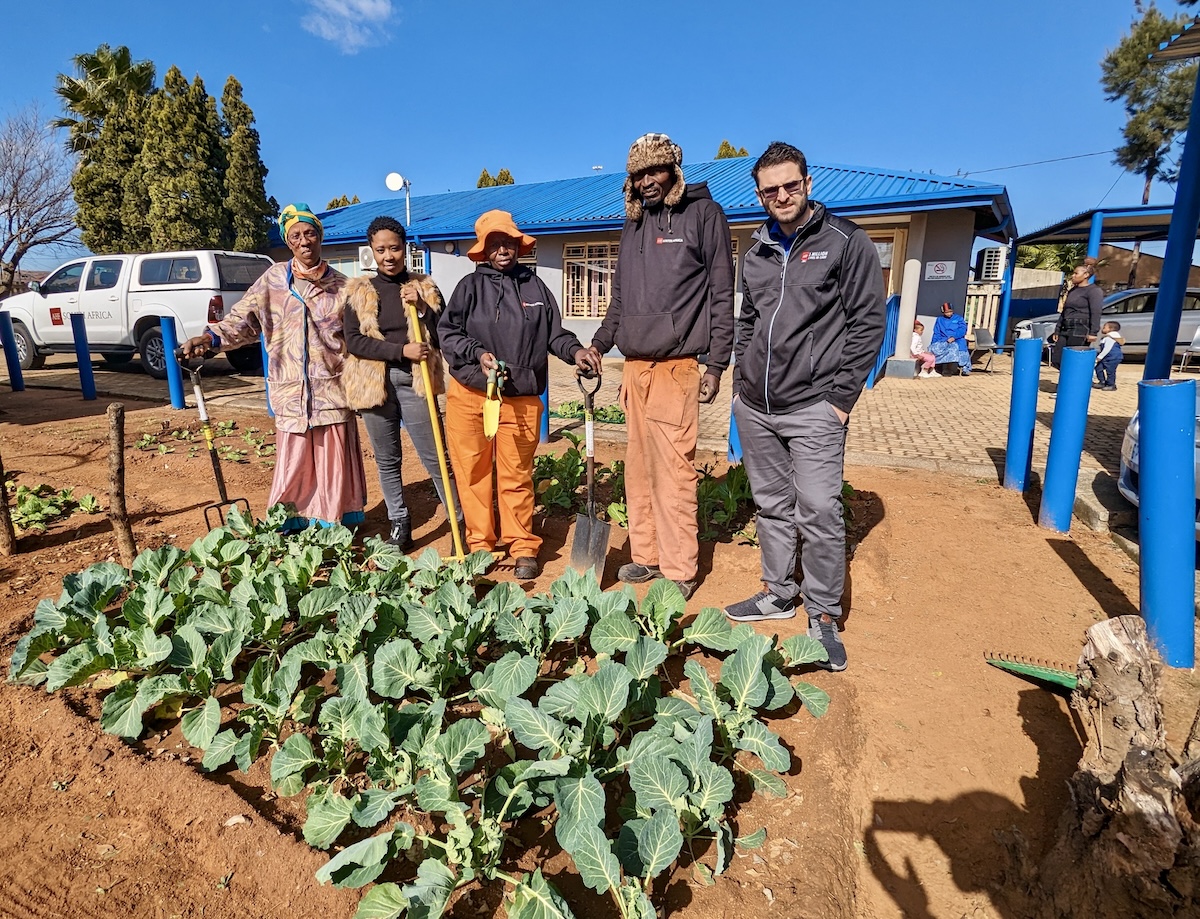
At a government HIV treatment site supported by AHF, we visited one of our Food for Health projects that helps address food insecurity through nutrition education, community farming, and livelihood support. A small plot in the clinic yard allowed clients to grow vegetables using tools and training provided by the program. Participants ate some of what they harvested and sold the rest to earn additional income, improving their food security and supporting continuity of HIV care.
The patient-farmers proudly showed us their crops. What struck me (pictured above, far right) was that the garden did more than provide food. It turned the clinic from somewhere people simply received care into a place where they could grow, produce, and contribute.
Later, we visited a local Girls Act chapter, an AHF initiative which empowers girls and young women to take charge of their health and develop practical skills to thrive. The girls were electing new officers while eating chicken sandwiches, chips, and soft drinks. An AHF coordinator quietly told me that, for some of them, this might be their only meal that day. That stayed with me.
Public health discussions often focus on medicines, clinics, and health systems, all of which are essential. But health also depends on whether someone has enough to eat. Hunger affects physical health, mental well-being, education, and resilience against disease. It can also make every other health intervention harder.
World hunger is easy to discuss as a statistic. It is harder to treat as an abstraction when the person in front of you may not eat again until tomorrow.
Most of us cannot solve hunger, but nearly all of us can help feed someone.
Denys Nazarov is the Director of Global Policy and Communication at AIDS Healthcare Foundation. He has been with AHF for more than 17 years.