
When drugmakers began restricting contract pharmacy use in 2020, the companies considered they had a win-win scenario. Either they would win in the courts, setting a legal precedent for limiting the number of prescriptions available at 340B prices or their coercive tactic would force lawmakers to take up their goal of broader 340B reform, in which some of their restrictive practices would become law.
Contract pharmacy restrictions interfere with how eligible nonprofit healthcare providers use retail pharmacies for dispensing prescription drugs that qualify for discounted prices. The 340B Drug Pricing Program allows nonprofit healthcare providers to purchase prescription drugs at discounted prices, helping them generate savings they plow back into care for low-income patients. Drug companies use restrictions as a means for reducing the number of prescriptions they have to sell at a discount; fewer discounted prescriptions mean more profit.
Drugmakers did not predict the bipartisan backlash at the state level. States understand that if their nonprofit providers have fewer 340B dollars to subsidize health services, then state Medicaid programs would have to pick up the slack. If low-income Americans cannot get care at their nonprofit provider, those patients will seek care elsewhere – likely clogging up urgent-care centers for primary health services and leaving Medicaid, and thus the taxpayer, on the hook.
In 2020, six drugmakers announced their first rounds of contract pharmacy limitations. Fast forward to today and more than 40 drugmakers have instituted some type of limits on where and which of their products they make available at retail pharmacies. Did companies think states would just acquiesce to an onslaught of new patients ending up on their Medicaid rolls?
As the map from the 340B Report shows, 22 states have enacted contract pharmacy protection laws. Two others have had bills clear at least one legislative chamber. In 2025-2026, seven additional state legislatures introduced pharmacy access legislation.
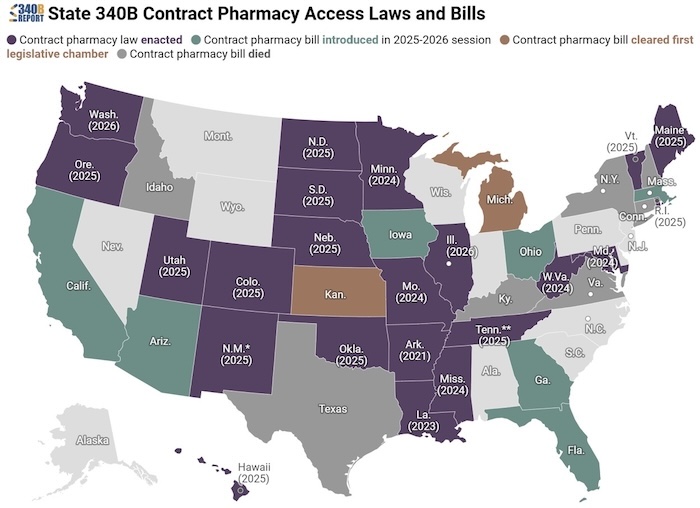
340B Report
Perhaps drug companies will succeed in their goal of comprehensive 340B reform at the federal level. Even if they are successful, that reform may not include preemption provisions that prohibit state contract pharmacy laws. Drug companies are banking on the much more arduous process of passing a bill at the federal level, while states outmaneuvered them by enacting 340B pharmacy access laws across the country. Drugmakers expected little to no pushback – they were wrong.
John Arcano is Senior Manager of Policy and Government Affairs at AIDS Healthcare Foundation.