



Andrij Khaetskij is AHF Ukraine’s Wellness Center Coordinator in Odessa. His story is next in our “I Am AHF” series featuring remarkable staff, clients, and partners who are doing what’s right to save lives everyday.
Interviewed by Diana Shpak, Knowledge Management Focal Point, AHF Europe.
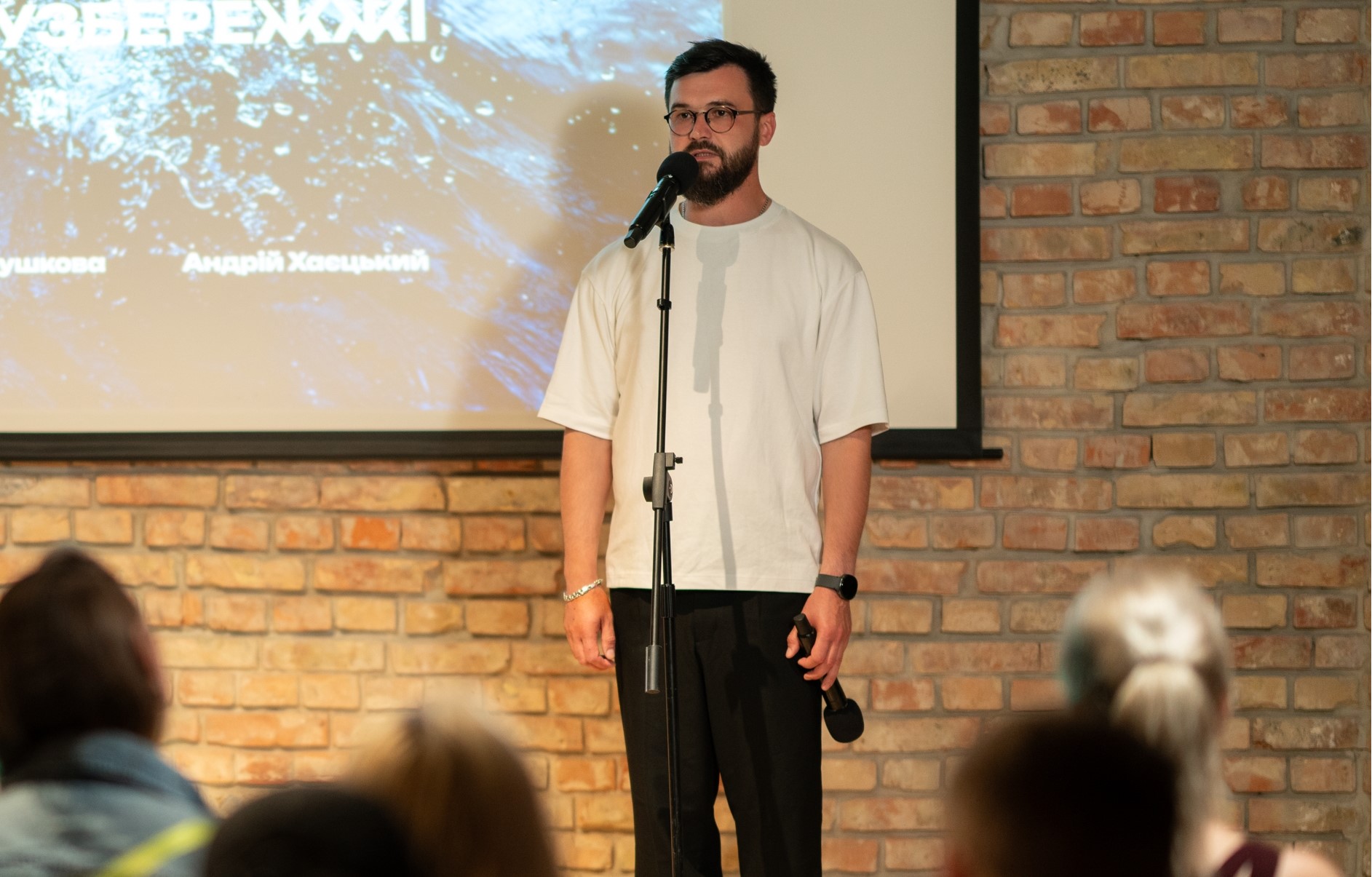
AHF touches thousands of human stories, and among those, thousands are people of genuine talent whose voices carry far beyond the walls of a clinic. One of them is Andrij Khaetskij, coordinator of the AHF Wellness Center in Odesa, Ukraine. Alongside his daily work at AHF, he remains a poet—a voice heard not only in a small counseling room, but also from the pages of books and the stages of literary festivals.
Andrij Khaetskij joined AHF in December 2021, when the Wellness Center space had not even been renovated yet, conducting testing alongside a fellow nurse. “I have learned to do the testing from absolute zero,” he says.
The project officially opened in the summer of 2022. Today, the Wellness Center team consists of three people, working side by side with the clinic. “We consider ourselves one team,” Andrij explains. In his view, that is the greatest strength of this model. If someone comes in for testing and receives a positive result, they are not sent off somewhere across the city to look for help. They are handed over to doctors right away, just next door. “A person does not have time to get lost in that stress. That is one of the real benefits of being right next to each other.”
Taking the job was not easy for Andrij. A few years earlier, he had lost two close friends who died after refusing HIV care. “They both died without ever starting treatment,” he says. There was another obstacle, too—the fear of stigma. How would people react if they found out he worked in HIV prevention and treatment? What helped ease his doubts was a chance conversation with former colleagues, who, on hearing about the job offer, answered without hesitation, “That is wonderful; do not even think twice—go and work.” That support, together with the memory of the friends he had lost, became the deciding factor.
Andrij calls one case among the most striking of his entire career. In 2022, a man walked into the center and announced right from the doorway that he already knew his HIV status and did not need to be tested. It turned out he had been diagnosed back in 1997, right after his release from prison. He went to the hospital, but they treated him very badly there.
“I never went back to them,” the man said, describing his only contact with the medical system a quarter of a century earlier. For 25 years, he had not sought treatment, returning only after his health had begun to decline sharply. In the end, the story had a happy turn. He started therapy, and both his wife and their daughter tested negative for HIV.
There are stories that go the other way, too. One young man had been taking PrEP regularly for two years. Then he fell in love, trusted his partner, stopped taking the medication, and within a month, tested positive.
Talking about PrEP, the medication used to prevent HIV, Andrij explains that people come to it from very different walks of life: men who have sex with men and often change partners, partners of people living with HIV, and sometimes sex workers. He is personally fairly skeptical of the “on-demand” dosing schedule, which requires timing the medication precisely around sexual contact. “It can fail, because there is this element of passion involved.” When followed correctly, however, on-demand PrEP is an effective HIV prevention option for eligible people.
Even so, quite a few of his clients use exactly that approach. Andrij adds an important message: PrEP only protects against HIV, not against other sexually transmitted infections. Condoms remain an important tool for reducing the risk of other STIs.
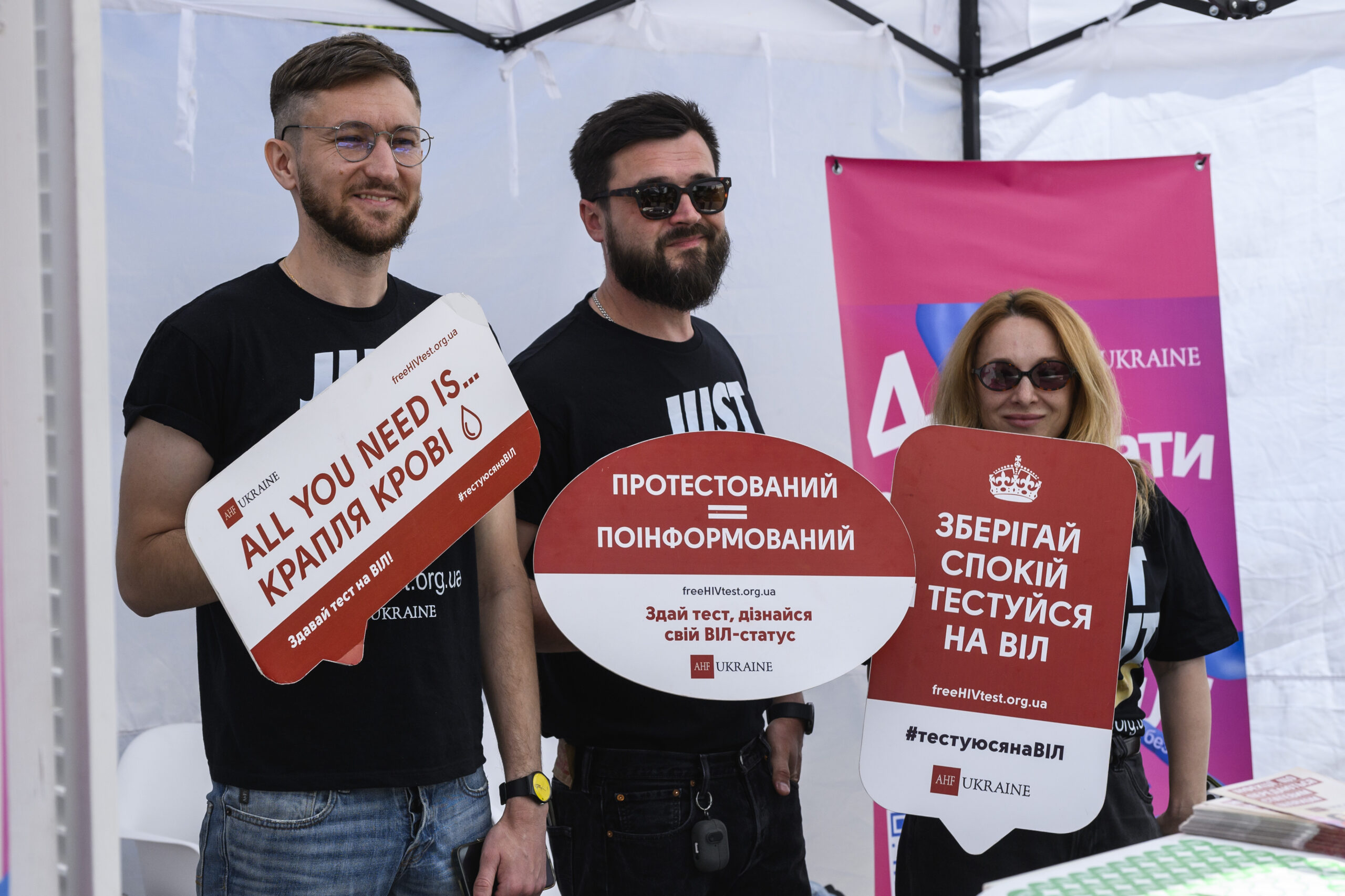
For Andrij, working at AHF is not just a job. His grandmother lived through the Holodomor, a famine in Soviet Ukraine in the 1930s, and as a child, she made a promise to herself to grow up, earn money, and never go hungry again. “When she told me that story, I remember thinking that when I grew up, I would start earning money and helping people,” he says.
Every day, whether he is testing someone or sitting with them in conversation, Andrij tries to make the news of a diagnosis land a little more gently. “Everything will be fine, life goes on, and it can still be a healthy life,” he tells the people who have just learned their status.
Alongside his work at AHF, Andrij lives another life, a poetic one. He was born in Odesa, but after first grade moved to live with his grandmother in the village of Liubashivka, where he spent the next 10 years and finished school. Despite all those years in nature, Andrij is certain of one thing: He is a person of the sea. “It is hard for me to be in cities without a sea nearby,” he says. “I consider myself a completely maritime person.”
Here is one of his poems, translated by Ilya Kaminsky, an American poet of Odesa origin:
The streets, the streets,
in squares precise,
what happened once
will happen twice.
The glance, the half-smile,
the hands’ small music
How a quiet
stays, in losing.
Stones, stones
chiseled to dust,
polished like excuses
But not for us.
Eyes too open
the edges bare,
what’s still to come
is already there.
Streets, streets,
squared streets
the years wear thin
what’s still to come has always been.
His first poetry collection, Three Dots, came out in 2016. A few years ago, Andrij was invited to submit his application to PEN Ukraine (a human rights organization that aims to protect Ukrainian literacy and culture). “I was just doing what I always did, writing poems,” he says. Last year, Andrij became program director of the PORT literary festival, something he admits gave his confidence a real boost. Writing to authors he had admired for years and hearing back, “Yes, I would be glad to accept the invitation to the festival!” still feels like a small miracle every time.
A person of the sea. A poet who chose, deliberately, to write exclusively in Ukrainian. And a man for whom the greatest happiness is this: that after the hardest news imaginable, someone still hears him say that life can go on. Somewhere in the quiet of Odesa’s streets, among stones worn to dust by time, his poems keep being born about how everything still waiting to happen has, in truth, already always been.