


Giorgos Keratsas is the Communications & Advocacy Officer for Positive Voice in Greece, an AHF partner for 14 years, that works to defend the rights of people living with HIV, confront the spread of HIV/AIDS, and reduce its social and economic impact. His story is next in our “I Am AHF” series featuring remarkable staff, clients, and partners who are doing what’s right to save lives every day.
Interviewed by Diana Shpak, Knowledge Management Focal Point, AHF Europe
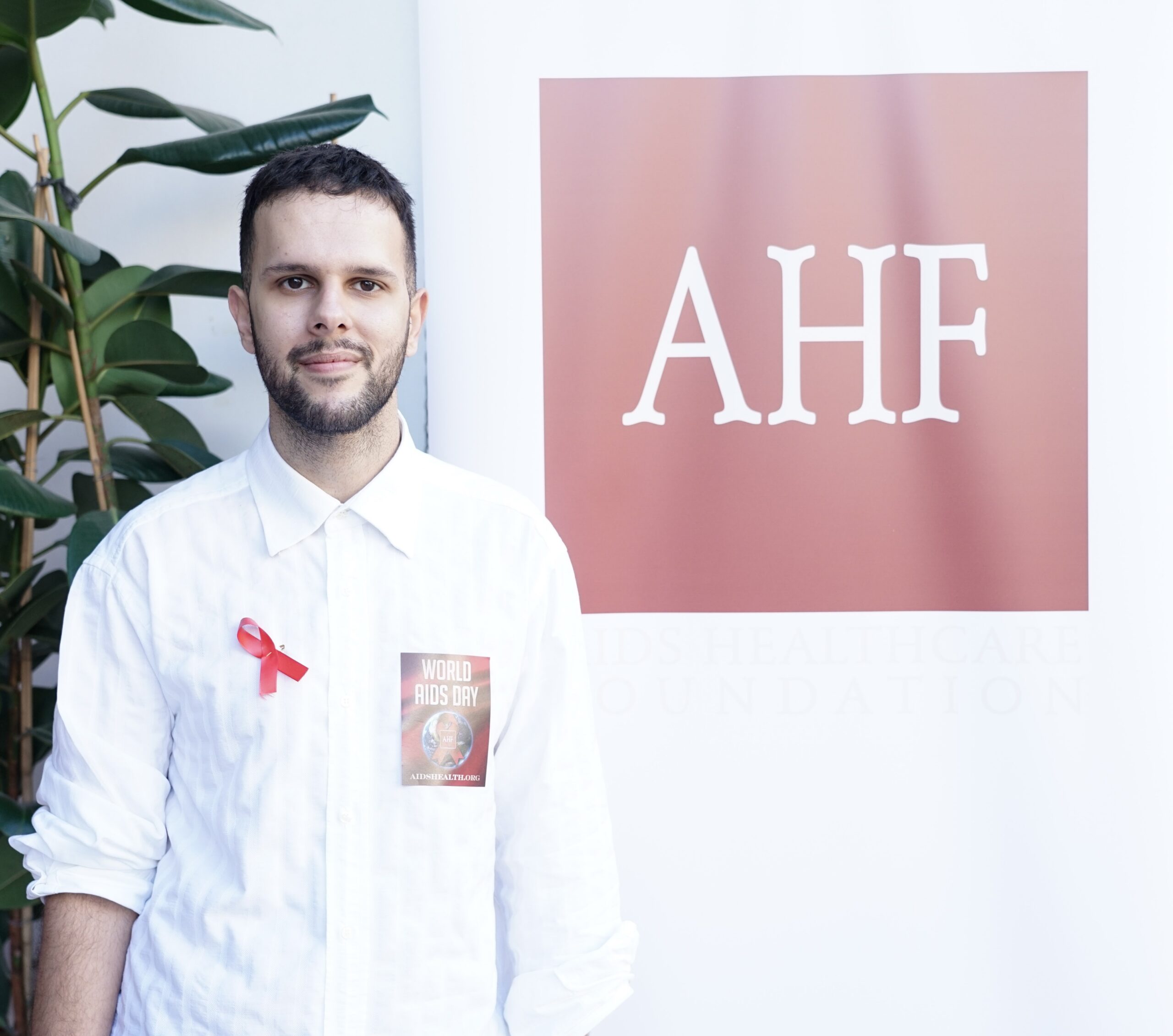
Giorgos Keratsas comes to this work with a background in psychology, having studied in Athens and later at the University of Amsterdam. Today, he uses that knowledge in HIV advocacy and communications to help shape messages that inform, challenge stigma, and reach people where they are.
This interview is an opportunity to learn from his journey: what brought him into the HIV field, what Positive Voice is doing in Greece, and how communication can become a powerful tool for change.
At the age of 18, during his first year at university, he visited Athens Checkpoint for HIV and syphilis testing. The experience stayed with him. In Greece, where sex education is still largely absent from schools, many young people grow up without clear information about STIs, prevention, or protection. At Athens Checkpoint, Giorgos found something different: openness, safety, and a space where sexual health could be discussed without shame.
That experience inspired him to become a volunteer with Positive Voice. After completing his master’s degree in Amsterdam and returning to Athens, the relationship naturally grew into a professional one. In 2021 he began working as a counselor and tester at Athens Checkpoint.
For one year, Giorgos provided testing and sexual health counselling. Later, he combined this work with communications, until the communication and advocacy projects became his main focus.
His first reactive test result came during training. He remembers feeling shocked at first, but his colleague guided him through the process, and the client himself was calm and prepared. That moment taught Giorgos an important lesson: “Testing is not only a medical procedure. It is also about trust, support, and creating a space where people can face the result without fear,” said Giorgos.
He also remembers moments when the result was difficult for people to accept. For example, an older man, around 65 years old, who received a reactive result for both HIV and syphilis. Giorgos felt that the man did not yet understand what HIV means today, that it is treatable, and that HIV is not the same as AIDS.
“He was very shocked,” Giorgos recalls. “He needed a lot of empowerment and support.”
For Giorgos, that moment showed how important counseling is.
After a year at Athens Checkpoint, Giorgos moved fully into communications and advocacy. Today, he is responsible for the public voice of Positive Voice.
“At the moment, I am the only person managing the organization’s communications,” he explains. “This includes marketing, social media, media relations, basically anything public facing on behalf of Positive Voice.”
He also supports advocacy work and fundraising, including writing proposals and helping secure additional funding.
When Giorgos started shaping communications for Positive Voice and the Checkpoint centers, he knew one thing clearly: In Greece, HIV and sexual health are still surrounded by fear, silence, and taboo. His goal was to change the tone.
“My first idea was that we had to make it more fun and more approachable,” he says.
Instead of only posting direct messages about testing or prevention, Giorgos began creating content that speaks about sex, sexual health, and everyday experiences in a more engaging way. Sometimes the message is direct. Other times it is more subtle, aimed at drawing people in first and opening space for conversation later.
“Because these issues are serious and important, and because they carry a lot of stigma, sometimes you have to be less formal and a bit more fun,” Giorgos says. “That’s often the best way to connect with people and communicate the message you want to share.”
His approach is simple but powerful: use humour, curiosity, and relatable content to open the door. Then, once people are engaged, promote testing, prevention, and sexual health in a way that feels less frightening and more human. Positive Voice is active mainly on Facebook, Instagram, and its website.
Campaigns are one of the strongest parts of his work and his favorite. Among other projects, he has created a video campaign for the 2024 International Day of the Girl Child featuring the popular Greek journalist Natasa Giamali, which gathered more than one million views; a promotional campaign inspired by queer nightlife for the services of the Checkpoint centers; and a series of promotional initiatives for European Testing Week, during which dozens of Greek artists, journalists, and influencers visited the Checkpoint centers to get tested and encourage their audiences to do the same.
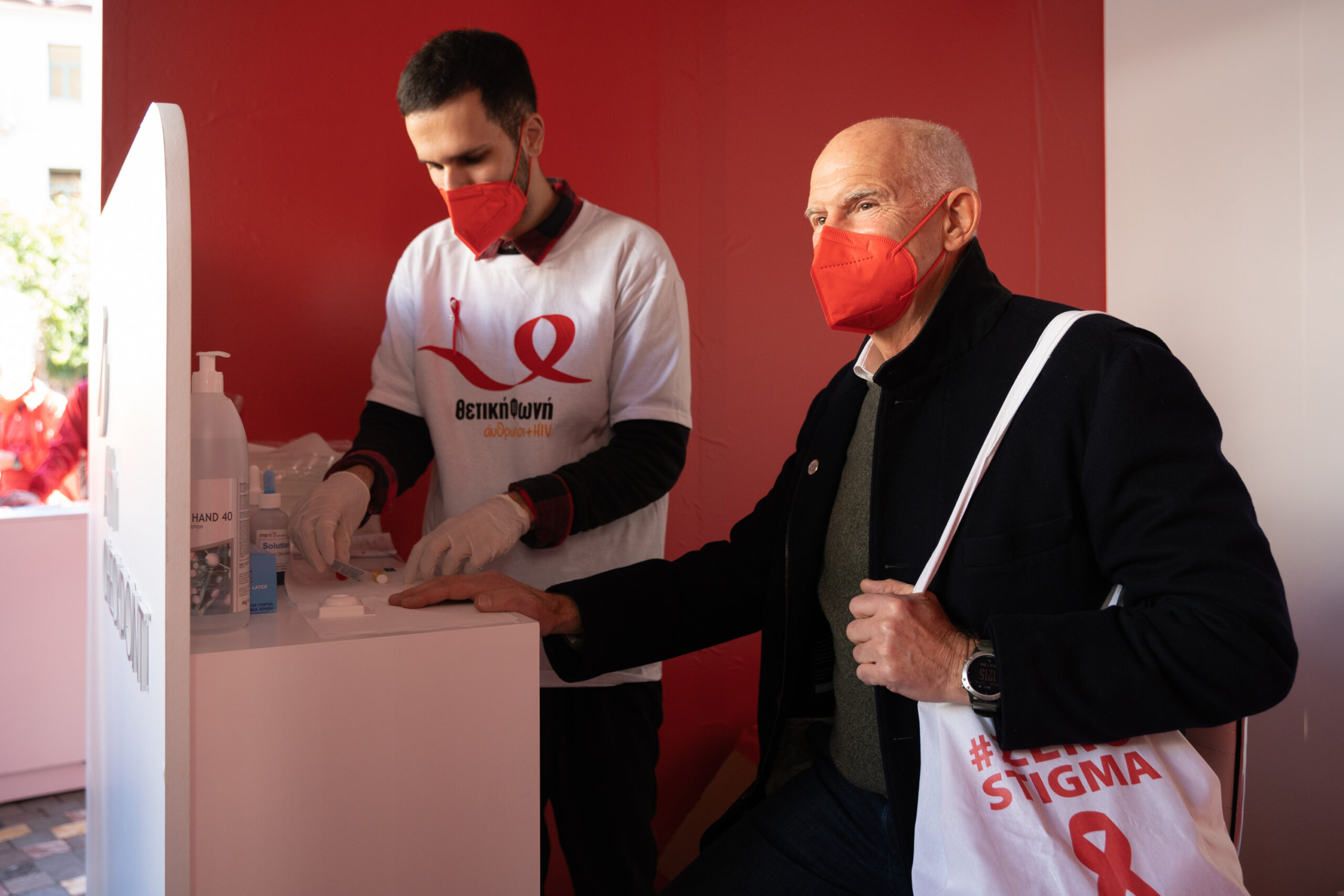
Giorgos Keratsas administering an HIV test to former Greek Prime Minister George A. Papandreou during Positive Voice’s World AIDS Day event in 2021.
“It’s my favorite part because I really like the creativity,” Giorgos says. “AHF always allows me to be creative. The procedure is that I come up with an idea and submit a plan, which always gives me – and partners from other organizations – freedom and flexibility.”
He values the way AHF provides a global message and visual direction, while still giving partners space to adapt campaigns locally. “We get materials from AHF, like the main message or the main artwork, but we adjust it to our country and to what works for our population.”
Both Positive Voice and Checkpoint have built a strong online presence. On Facebook, each page has more than 10,000 followers, and on Instagram around 6,000 each. Their outreach goes far beyond social media. Positive Voice also works with the media, accepting interviews, articles, and public opportunities whenever possible.
“Whenever they invite us, we always say yes,” Giorgos explains. “We view this as a great opportunity to showcase what we do and to open a discussion for topics that are rarely talked about in the pubic sphere.”
Another important tool is word of mouth, especially through street work and outreach activities.
For Positive Voice, outreach is not only about providing services, but also about building trust.
“We provide testing in the street, condoms and leaflets, but our work in the field is also a way to promote our centers and invite people to get tested.”
This visibility becomes especially important during public campaigns such as International Condom Day, World AIDS Day, and other awareness events.
“It makes a lot of impact,” Giorgos says.
Thanks to AHF, Positive Voice now has testing locations in Athens and Thessaloniki, as well as a dedicated testing service in Athens for refugees, migrants, and asylum seekers.
“The biggest part of what we do as an organization is supported by AHF,” he explains.
For Giorgos, this support is not only about tests, condoms, or services. It is also about advocacy, campaign materials, education, and training. For Positive Voice, the partnership with AHF is not just financial or technical. It strengthens the work, expands access, and helps the organization reach people who might otherwise remain unseen.
Giorgos sees the partnership with AHF as essential to the way Positive Voice works today.
“It is a vital collaboration,” he says. “If we did not have this cooperation, we would not be working the way we do.”
When asked about his own future, Giorgos is honest. He does not speak in big, fixed plans. Instead, he focuses on the work that is happening now and on making it stronger.
“I hope that we keep doing what we do,” he says, “and that our work becomes more impactful, more influential, more important year by year.”
“When you do your everyday office work and try to meet deadlines, you sometimes miss the bigger picture,” he reflects. “But when you come in touch with the public and hear people explain what they have gained through our work and our services, you really understand that it is important and that it needs to be continued in the future.”
For Giorgos, better communication starts with knowing exactly who you want to reach. He believes HIV communication must also become lighter and more human. For small organizations, reach can be limited but partnerships can make the message stronger.
“By collaborating and building relationships with other organizations, media, or networks, we can always amplify what we do,” said Giorgos.
In his view, communication is not only about visibility. It is about understanding people, speaking in a way they can hear, and making sure that life-saving information reaches those who need it most.
For those just starting in the HIV field, Giorgos offers advice that is both practical and deeply human: Start with knowledge, training, and confidence in your role.
“All the work you do starts with yourself,” he says. “Whether you work in the field providing services or in communications, you must first be equipped with knowledge so that you can feel confident and prepared in your role.”
For him, training is not only about technical skills. It is what allows a person to feel comfortable and responsible in front of others especially when working with people who may be vulnerable, unsupported, or part of marginalized communities.
He also reminds new professionals that they do not have to carry the whole world on their shoulders. In this work, not every problem can be fully solved, but every sincere effort matters.
“Sometimes we cannot do everything,” he says. “But we do our best, and that’s what counts.”
Communication is not only about posts, campaigns, or visibility. It is about connection. It is about making knowledge accessible, reducing stigma, and bringing support closer to the people who need it most.