
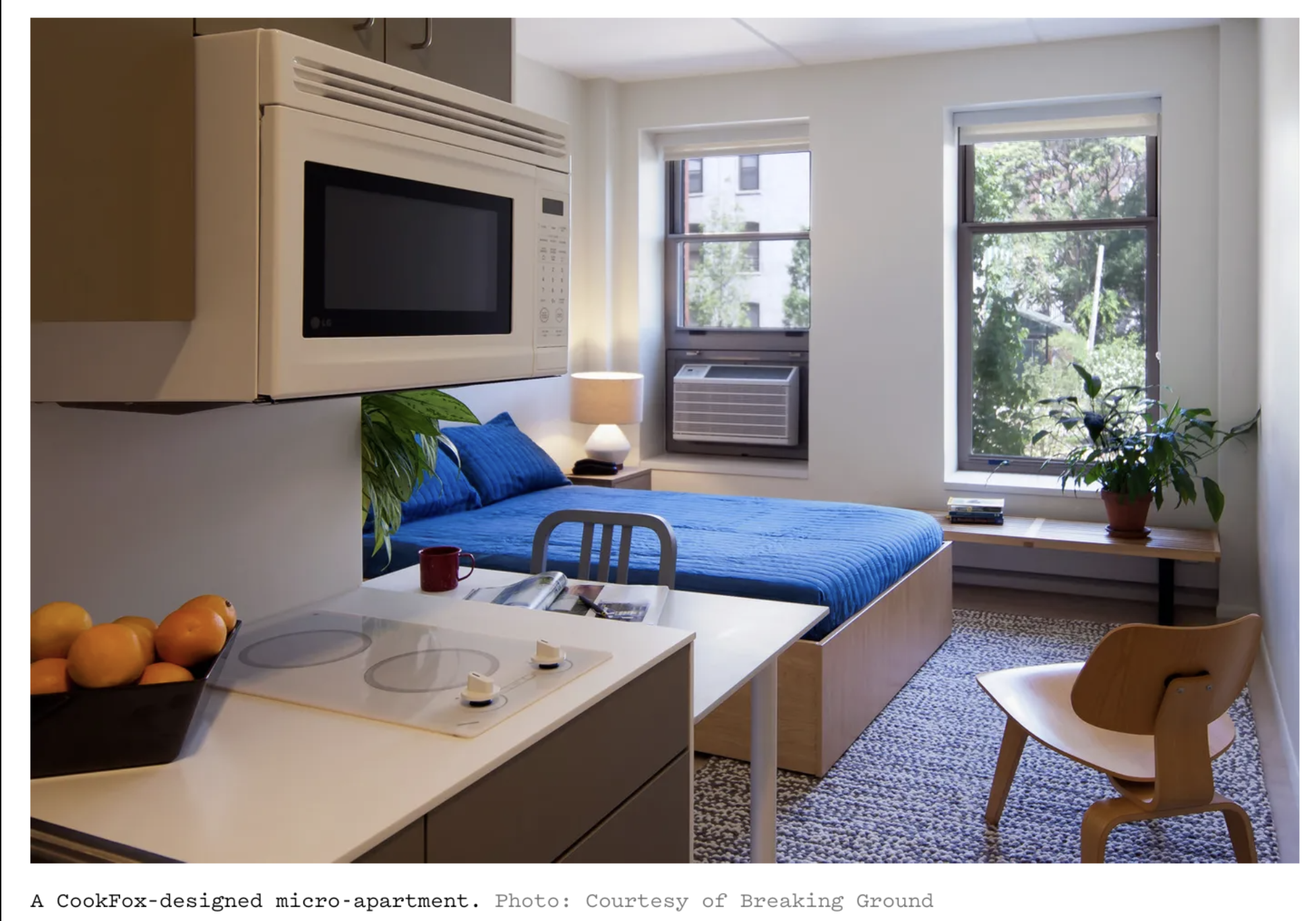
New York City is trying a “new” old approach to address its homelessness and housing affordability crises: single-room occupancy hotels, also known as “SROs.” It’s a promising development, as SROs—newly built or ones that have been repurposed—can go a long way to help save lives by moving vulnerable and extremely low-income people off the street into stable, affordable housing.
Last November, Eric Bottcher, a New York City Council member who has since been elected to the New York State Senate, introduced a bill that “…would permit the creation of shared housing rooming units in new class A multiple dwellings or buildings converted to class A multiple dwellings.”
In layman’s terms, Bottcher and the city council are looking back to the first half of the twentieth century, when single-room occupancy hotels were a widespread form of reliable housing stock, as inspiration for the city’s future.
SROs fell out of favor in the mid-20th-century when many jurisdictions banned or restricted them (starting with New York City in 1955) due to concerns over poverty, overcrowding, and crime.
However, in recent years, homelessness exploded, and housing affordability became a front-burner issue for many cities. So housing groups and nonprofits, such as Healthy Housing Foundation, the housing provider division of AIDS Healthcare Foundation, began buying and refurbishing old SROs and motels, including two in New York City, to repurpose as permanent housing for extremely-low-income and formerly homeless individuals.
The twist in New York? Bottcher’s bill would permit the construction of brand-new single-room occupancy hotels, the conversion of office buildings, and the refurbishment and repurposing of older SROs for use as permanent housing.
These SROs would mostly have shared bathrooms and kitchens, with some housing units as small as 100 square feet. They would also rent for far less than apartments.
At the introduction of Bottcher’s bill, The New York Times wrote: “There are about 30,000 to 40,000 (SROs) left, down from more than 100,000 in New York City in the early 20th century, according to a 2018 study from the N.Y.U. Furman Center.”
New York’s shift toward exploring new and old SROs as inexpensive housing overlaps with a similar trend toward micro housing units for people of all incomes and walks of life, according to Steinberg Hart, an award-winning architectural and planning firm based in California.
“Micro-housing units—typically compact apartments under 350 square feet–intersect with hipster culture through a shared ethos of minimalism, urban core living, and experiential spending over material accumulation,” the firm Steinberg Hart recently noted in a report. “Young urban professionals and creatives often trade private square footage for walkable access to cafes, co-working spaces, and nightlife.”
Trendy, higher-end micro units may also extend tacit approval to cities like New York to explore SROs more fully—both new and old—as affordable housing stock.
The Times article noted that “the push underscores how an extreme shortage of housing has led to a turnaround in attitudes toward forms of shared housing, which have long been a controversial feature of cities worldwide.”
So, to address our nation’s growing affordability and homelessness crises more swiftly and effectively, public leaders, housing officials, and nonprofit organizations working in the arena should look inside and outside the box at newly built SROs, as well as older, repurposed ones, as very real and workable solutions.
Ged Kenslea, Senior Director of Communications at AIDS Healthcare Foundation, has worked on public health issues for 30 years.