
Suleiman Umoru is an AHF volunteer. His story is next in our “I Am AHF” series featuring remarkable staff, clients, and partners who are doing what’s right to save lives every day.
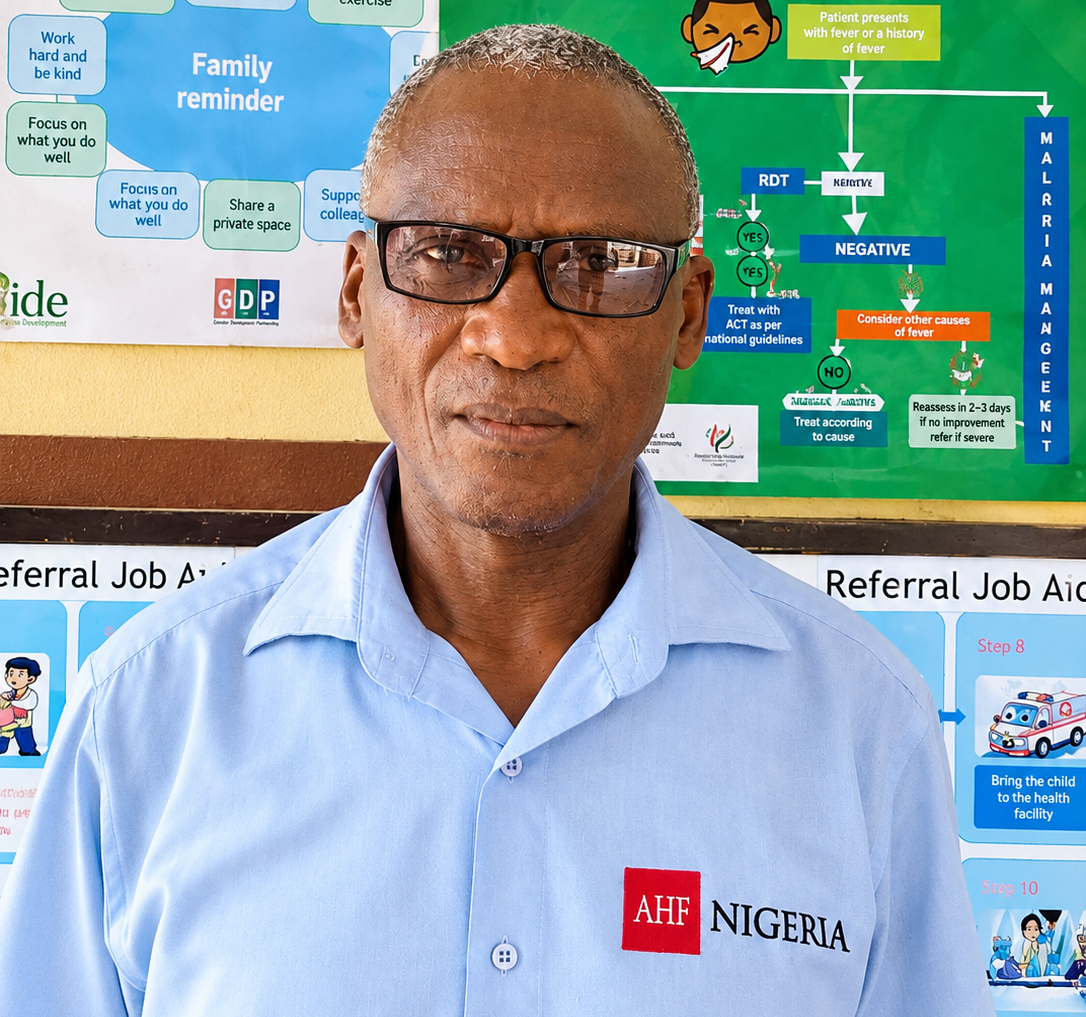
I was born the second of six children in Lagos, Nigeria, and began my early education there. After secondary school, I began working as a clerical staff member at an insurance firm in Lagos. In 1990, I was transferred to Yola, Adamawa State, where I married and had two children before moving to Jos in 1997.
At the time, there was very little accurate information about HIV in my community. People rarely talked about it openly, and many of the conversations that did happen were based on fear and misinformation. HIV was often associated with promiscuity, witchcraft, or spiritual attacks. We understood HIV to be an incurable disease, which contributed to the stigma surrounding it. Even the images commonly used to represent people living with HIV showed people who were extremely thin and appeared close to death.
I was diagnosed with HIV in November 2001 after becoming sick repeatedly. My condition gradually worsened until I developed uncontrollable diarrhea and pneumonia. After several tests and treatments failed to improve my condition, an HIV test was recommended at Jos University Teaching Hospital. When the result came back positive, I was not completely surprised. By then, I was extremely sick and could barely walk without support.
My first thought was about my wife, who was eight months pregnant at the time, and the safety of both her and our unborn child. My wife was the first person I told about my status, and she was also tested and found to be HIV positive. I later found the courage to tell three of my surviving brothers and a cousin. They supported us during a very difficult time. For almost a week after my wife and I received our results, neither of us could sleep properly.
Antiretroviral therapy (ART) became available to us in early 2003. My wife and I were fortunate to be among the first groups of participants in an ART trial at Jos University Teaching Hospital.
Treatment was very different then. I took three tablets every morning and another three every evening. Our adherence was closely monitored, and we had to record each dose on log cards that were reviewed during clinic appointments.
Starting treatment gave me hope. I saw my health improve. The diarrhea stopped, I regained weight, and my appetite returned. For the first time, I could see that treatment could give me the opportunity to live a better life.
That hope was tested later that year when I was diagnosed with active tuberculosis. Because of concerns about drug interactions, my ART had to be suspended for at least eight weeks. I lost a great deal of weight, struggled with my appetite, and restarting treatment became difficult because I had almost developed resistance. But I continued.
I first learned about AHF through a friend and colleague while I was involved in HIV counseling and testing with another organization. Toward the end of 2012, I joined AHF as a volunteer, and two years later, I requested a transfer to the AHF Abuja Clinic.
As a community volunteer, I would start my day by reviewing the appointment register and identifying clients who were due for clinic visits. I called them two or three days before their appointments to remind them. I also followed up with people who had missed their medication pickups or had been lost to care, including some whose follow-up dated back several years.
One experience that stands out involved an Islamic scholar in the community where I work. He required couples planning to marry to be tested for HIV and publicly announced their results during marriage ceremonies. Later, one of his three wives tested positive. Partner testing revealed that he and another wife were also living with HIV, and all three are now in care.
The experience changed his attitude toward people living with HIV. He became more compassionate and understanding. Sometimes, personal experience can replace fear and judgment with understanding. As the saying goes, “If you’re not infected, you’re affected.”
Today, more than 20 years after my diagnosis, I remain on treatment and undetectable. Taking my medication has become part of my normal daily routine. Treatment is much simpler now. Instead of the six tablets I took each day in the early years, I now take one combination pill once a day.
Being on the other side of HIV care has changed how I see my own diagnosis. People now look to me for support, and I cherish being able to put smiles on people’s faces through my work. When I see a pregnant woman living with HIV give birth to a baby who tests negative, I am filled with a joy that is difficult to describe.
Stigma and discrimination still exist in Nigeria, but I want people to understand that HIV is not the end of life. Treatment has changed what it means to live with HIV, and people living with HIV can have healthy, fulfilling lives and continue to pursue their dreams.
More than 20 years after my diagnosis, I am grateful to be alive, healthy, and able to help others stay in care. AHF has given me the opportunity to turn my own experience into a source of support for others.