
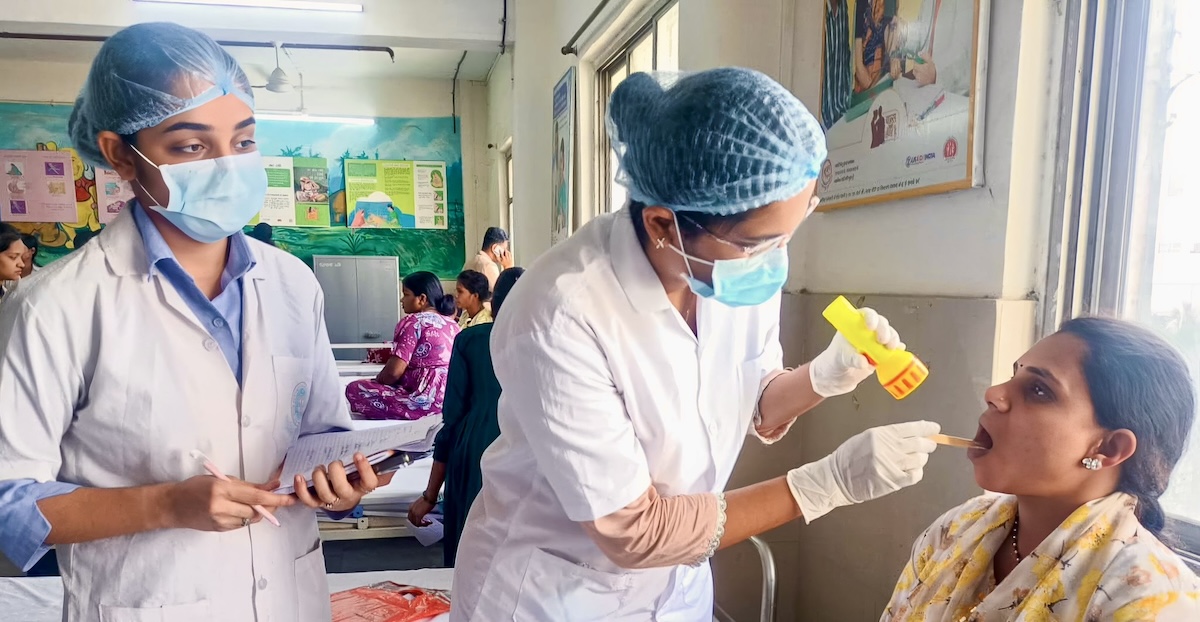
Persistence, shoe leather, elbow grease, and walking door to door are the decidedly unglamorous parts of public health work carried out by dedicated men and women. Yet such methods contain outbreaks, save lives, and control epidemics. Policymakers must recognize that frontline workers are one of our most important defenses against infectious disease, including HIV/AIDS.
Few places in the world make that clearer than HIV testing in far-flung villages, urban settlements, truck stops, and roadside communities in countries such as South Africa, Mexico, and India. Testing is the gateway to HIV services and treatment. Without it, the rest of what public-health wonks call the “cascade of care” simply won’t exist.
Some years ago, I got to see this frontline work firsthand in India.
One morning, an AIDS Healthcare Foundation doctor, our Sikh driver, and I left Delhi for a village about two hours away. Delhi makes you acutely aware that you are in a country of more than a billion people. Humanity seems to be everywhere, and traffic moves in a kind of orchestrated chaos capable of making even a strong-willed visiting driver weep.
I had another concern.
I was dealing with indigestion, affectionately known by travelers as “Delhi Belly,” and watched the city — and every plausible restroom — disappear behind us. As a seasoned road warrior fortified with Imodium, I understood that we had crossed a certain point of no return.
Eventually, fields gave way to a swampy landfill where dogs and the occasional cow rummaged through trash. Then we arrived.
Outside a rough cinderblock building, men waited their turn to sit with a community counselor and receive a rapid HIV test. A banner attached to the building announced the HIV testing event.
There was nothing high-tech about it: a couple of plastic chairs, a clipboard, referral information, and a box of test kits.
And that is precisely the point.
Communities like this are surrounded by small workshops and factories, and meaningful healthcare may require a person to take a long trip to a larger city. So for billions of people, the gleaming medical breakthroughs showcased at international conferences and pharmaceutical exhibitions can feel like another planet away.
Yet a trained counselor sitting in a plastic chair can find someone living with HIV, connect that person to treatment, and potentially change the course of a life — and help to control the spread of HIV.
It is slow. It requires trust. It requires counselors willing to travel, knock on doors, set up tables, and have the same conversation hundreds of times. But it works.
Public-health policymakers and experts sometimes talk about community public health as though it were an artifact of the eras of cholera, typhus, and influenza epidemics. It isn’t. Technology changes. Pathogens change. Human beings do not.
The underappreciated frontline health worker with a clipboard and a box of test kits is essential for controlling the spread of HIV and other diseases. He or she will always save lives.
Denys Nazarov is the Director of Global Policy and Communication at AIDS Healthcare Foundation. He has been with AHF for more than 17 years.